
The history of the Senlis family shows why genealogy and local history can be more complicated than a family tree suggests.
At first sight, the story seems straightforward. A French family from Senlis produced a man who came to England, married an heiress and became Earl of Northampton and Huntingdon. His descendants held those earldoms for three generations before the male line came to an end in the 12th century.
Behind that simple outline lies a mixture of medieval records, later genealogies and myths that gradually became accepted as historical fact.
Two works, published more than thirty years apart, are particularly useful in understanding the problem. The first is a French work by André Du Chesne, written about 1636, but not published (in French) until 1879. The second is a paper read by the Northampton historian Rev. R. M. Serjeantson in 1913. The later work makes considerable use of Du Chesne’s research, but also goes back to the medieval evidence and questions some of the traditional story.
The result is a fascinating example of how the historical record can be corrected — not by discovering an entirely new family, but by putting the surviving evidence in the right order.
To this picture, we can add modern archaeological evidence and reassessment of historical documents to understand the motives behind their creation.
High Butlers of France and Earls of Northampton
When we think of the Anglo-Norman aristocracy after the Conquest of 1066, our minds turn to Norman lords, grand stone keeps, and fierce dynastic squabbles over English soil. Yet one of the most fascinating families of the era managed to hold court at the very centre of power in two rival kingdoms simultaneously.
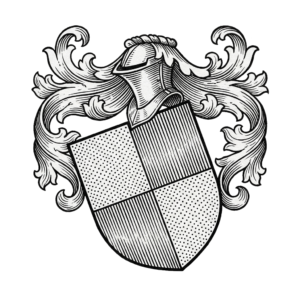
Quarterly Or and Gules
The House of Senlis (later known as Le Bouteiller) provided hereditary Grand Butlers1 to the Capetian Kings of France2 while sequentially furnishing three generations of Earls of Northampton and Huntingdon in England. Despite their prominent role in medieval Europe, their early history was obscured for centuries by monastic legends, local myths, and genealogical errors.
By examining two studies— André Du Chesne’s 17th-century French treatise, Histoire de la Maison des Bouteillers de Senlis3, and Rev. R. M. Serjeantson’s 1913 paper delivered to the Northampton & Oakham Architectural & Archaeological Society4 — we can partially unravel the history of the Senlis family and explore the lives of the four men named Simon de Senlis who shaped medieval Britain and France.
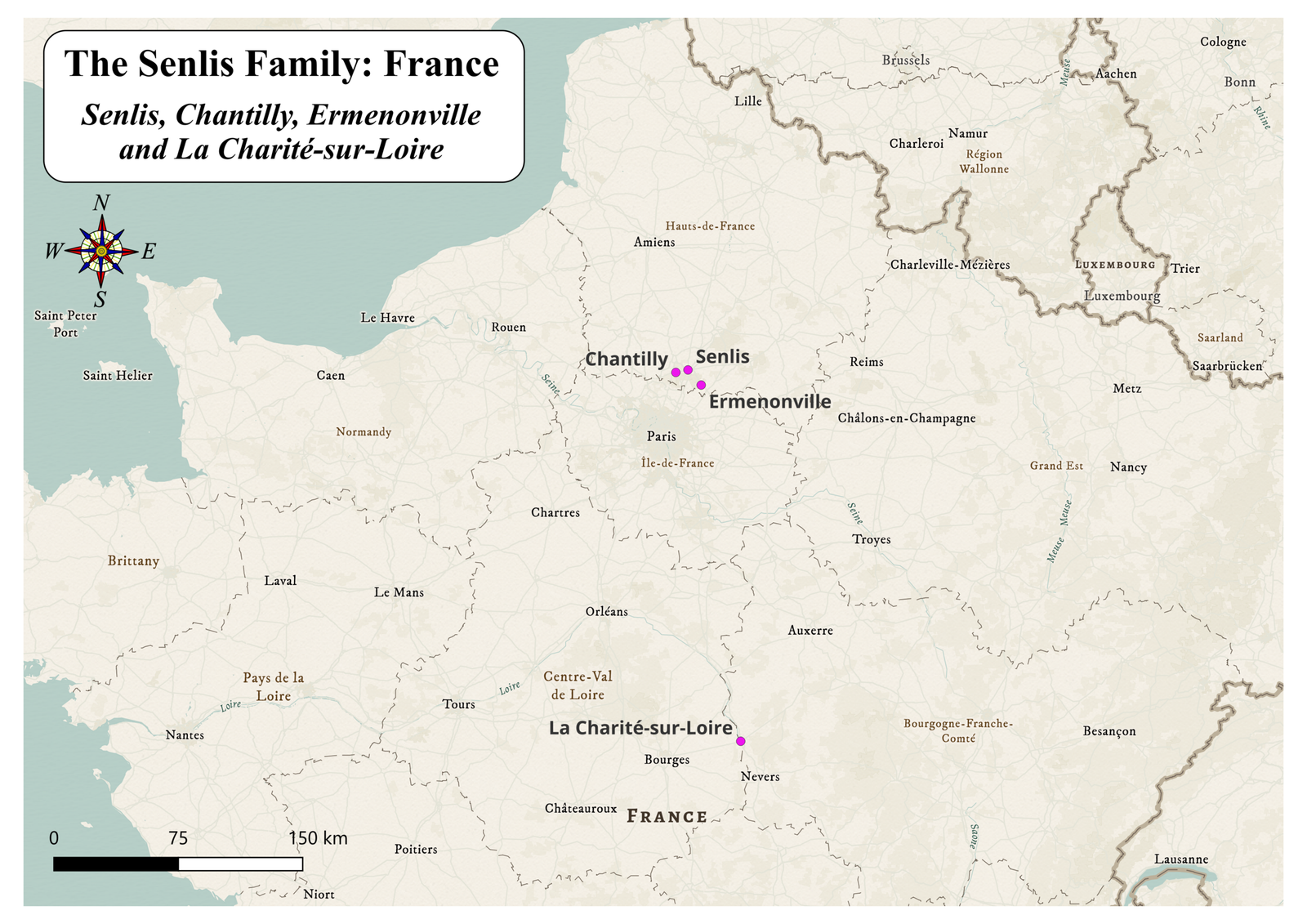
From French Court Royalists to Grand Butlers
The documented lineage of the Senlis family begins in the late 10th century with Rothold de Senlis, a French knight and Lord of Chantilly and Ermenonville who lived during the reign of King Hugh Capet (987–996). His descendants established themselves in the Île-de-France. Rothold’s son, Fulk de Senlis, served as a principal noble under King Robert II, while Fulk’s son, Landry de Senlis, married a noblewoman named Ermengarde during the reign of Philip I.
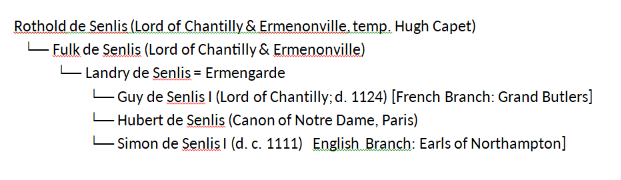
While Landry’s eldest son, Guy de Senlis I (also called Guy de la Tour), inherited the family’s French estates and founded the church of Saint Nicolas d’Acy, Guy’s sons elevated the family to high state office. Guy’s eldest son, Guy de Senlis II, was raised alongside Prince Louis (later King Louis VI). Upon ascending the throne in 1108, Louis VI appointed Guy II to the prestigious position of Grand Butler (Bouteiller) of France, one of the five primary officer roles in the royal household.
The hereditary office remained in the elder French branch for generations. In recognition of this court dignity, the family assumed the surname Le Bouteiller and adopted a distinctive coat of arms featuring five golden cups on a red shield (Gules five cups Or). While the elder line held the royal cup in Paris, Landry de Senlis’s third son, Simon I de Senlis, crossed the English Channel to carve out an empire of his own.
Debunking the Medieval Myths: “Ranulph the Rich” and the Lame Leg
For centuries, popular English history relied on colourful stories recorded in monastic texts, such as the Vita et passio Waldevi comitis, Ingulf’s Chronicle, and the cartulary of St. Andrew’s Priory, Northampton. These medieval accounts spun a dramatic tale of Simon de Senlis’s arrival in England5:
- The Commoner Myth: Monastic chroniclers claimed that Simon and his brother, Garner “le Riche,” were merely the sons of a wealthy French merchant or knight named Ranulph (Randal) le Riche who lacked high noble lineage.
- The Battle of Hastings: Legend asserted that Simon arrived in 1066/1067 with William the Conqueror, fought at Hastings, and was rewarded with the town of Northampton to pay for shoeing the King’s horses.
- The “Lame Leg” Rejection: The story went on to state that King William tried to marry his widowed niece, Judith (widow of the executed Anglo-Saxon Earl Waltheof), to Simon. Judith supposedly refused Simon because he limped on one leg (claudicabat). Enraged by her refusal, the Conqueror stripped Judith of her vast estates, forced her to flee into the marshes of Ely, and gave her lands—and her eldest daughter Matilda—to Simon instead!
| MEDIEVAL MONASTIC LEGEND | HISTORICAL FACT (Du Chesne / Serjeantson) |
| Ranulph le Riche (Commoner Merchant) | Landry de Senlis & Ermengarde (High Nobility) |
| Garnier le Riche (Brother) | Garnier de Senlis (Uncle) |
| Fought at Hastings (1066) | Arrived in England c. 1089 (Unmentioned in Domesday 1086) |
| Rejected by Judith for “Lame Leg” | Uncorroborated Myth; Married Judith’s Daughter Matilda |
Historical scholarship dismantled this narrative. André Du Chesne’s archival work proved that “Ranulph” was simply a textual corruption of Landry, and that Garnier was Simon’s uncle, not his brother. Furthermore, Rev. Serjeantson pointed out that Simon de Senlis does not appear anywhere in the Domesday Survey of 1086. In 1086, Countess Judith was still recorded in full, independent possession of her estates.
Simon probably arrived in England during the reign of William Rufus, marrying Matilda around 1089 and gaining his earldoms legitimately through her inheritance.
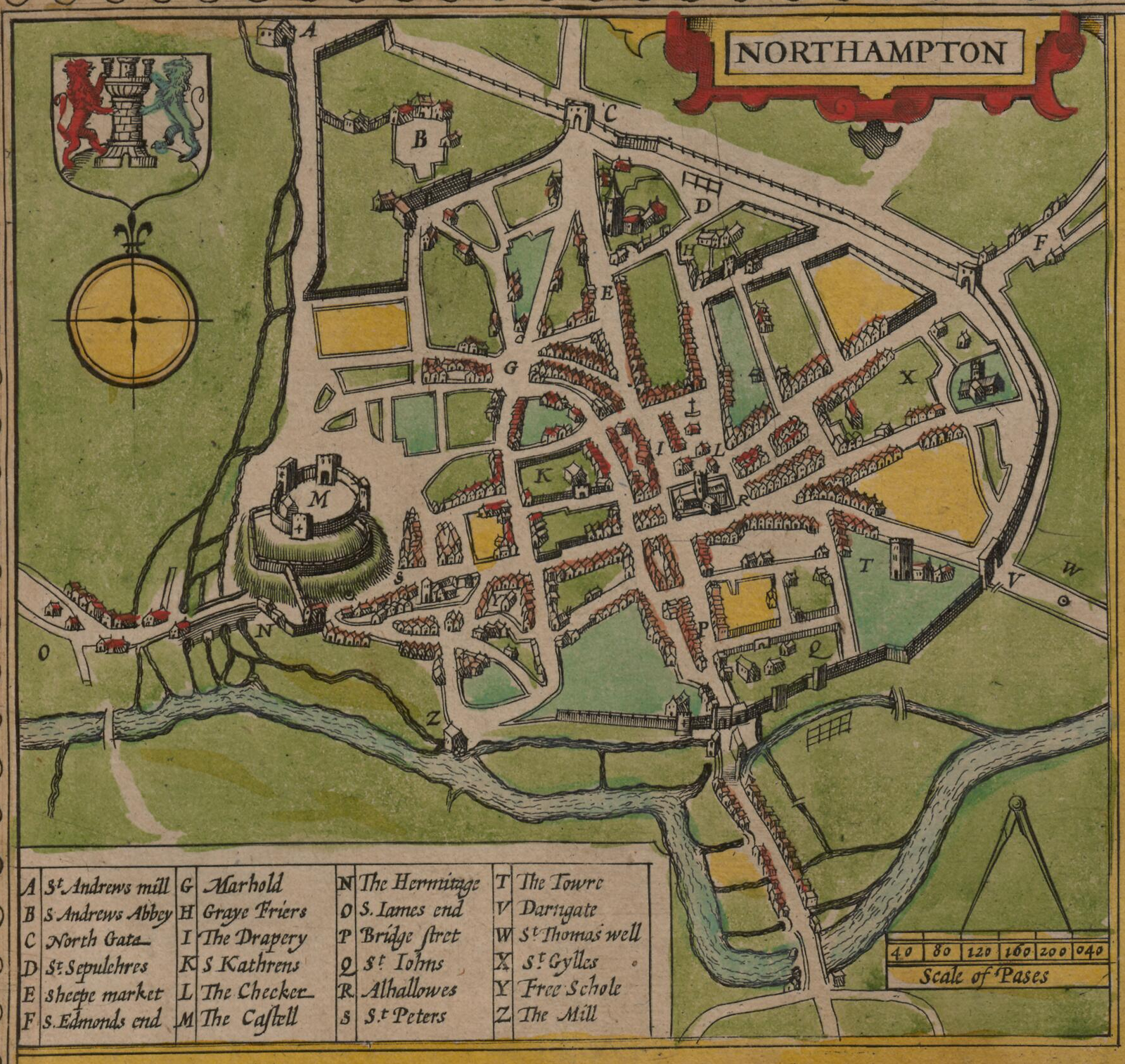
The Four Simons of Northampton and Huntingdon
The English history of the house revolves around four generations of men named Simon de Senlis. Each played a role in the political and religious life of Norman and Angevin England.
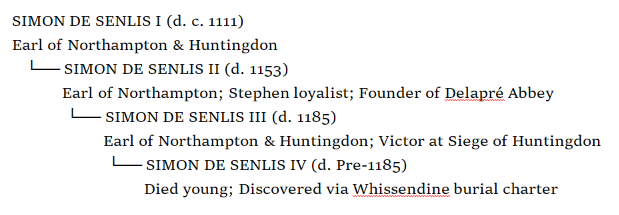
To this point, we now have a reliable family tree for the Senlis family from the 10th century through three generations in France and a further four generations in England. It is in England that the history associated with the family begins to unravel.
Now we will examine the next four generations and attempt to correct the narrative.
1. Simon I de Senlis (d. c. 1109–1111)
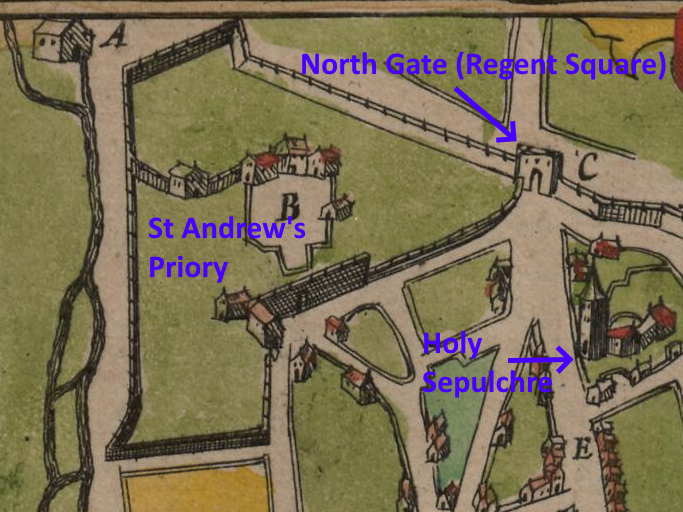
After acquiring the Earldoms of Northampton and Huntingdon through his marriage to Matilda, the medieval historical narrative attributes the commissioning of the original Northampton Castle and founding the Cluniac Priory of St. Andrew in Northampton. He is also credited with founding the famous round Church of the Holy Sepulchre in Northampton, inspired by his travels to the Holy Land.
Simon I, was a devoted crusader. After joining the First Crusade in 1095 and later serving King William Rufus in Normandy, he embarked on a second pilgrimage to Jerusalem later in life. Falling ill on his return journey, he died around 1111 and was buried at Priory of St. Mary La Charité-sur-Loire in France. This was especially appropriate as La Charité was the mother house of St Andrew’s Priory at Northampton. We cannot be certain, though, whether he died at La Charité or was transported there to be buried.
On closer examination, other parts of his story also begin to unravel. The castle is a particular problem: archaeological evidence suggests a construction date in the early 12th century, c. 1120. At the time of Domesday, 1086, all the Northampton and Huntingdon estates were held exclusively by his future mother-in-law, Judith, widow of the Saxon Earl Waltheof. We also know that Simon does not appear in Domesday and probably only arrived shortly before his marriage to Matilda c. 1089. By 1111 he was dead. Unless the ‘castle’ was some early modest structure, it is highly unlikely he was involved in its commissioning or construction.
There are further problems with the association of Simon with St Andrew’s Priory. A fledgling monastic community arrived in the town in 1083, settling at the church of St Martin, before being later moved to its permanent location in the north of the enclosed town. However, the priory’s own chronicle entry for 1083 has been edited by a later hand, adding that it was Simon who built the Priory in that year. A date when he had not arrived in England. It is more likely Simon was involved in the move of the priory to its larger permanent location.
It is also possible that Simon was indeed involved in the founding of the Church of the Holy Sepulchre in Northampton in the few years between the end of the First Crusade in 1099 and his likely return to Jerusalem, c. 1109-1112.
2. Simon II de Senlis (d. 1151/1153): The Civil War Loyalist
When Simon I died, his heir, Simon II, was still a minor. His mother, Countess Matilda, soon remarried David I, King of Scotland. Consequently, King David held the earldoms jure uxoris (in right of his wife), keeping young Simon II out of his patrimony for decades.
During the English Civil War between King Stephen and Empress Matilda, Simon II remained steadfastly loyal to Stephen. Simon II had regained the Earldom of Northampton after he fought at the Battle of Lincoln in 1141, where Stephen was captured, and continued fighting for the royalist cause at Winchester. Like his father, he was a monastic benefactor, relocating an abbey at Fotheringhay to Delapré Abbey in Hardingstone near Northampton and founding Sawtry Abbey in Huntingdonshire. He married Isabel (or Elizabeth) de Beaumont, daughter of the Earl of Leicester, and died in August 1153.
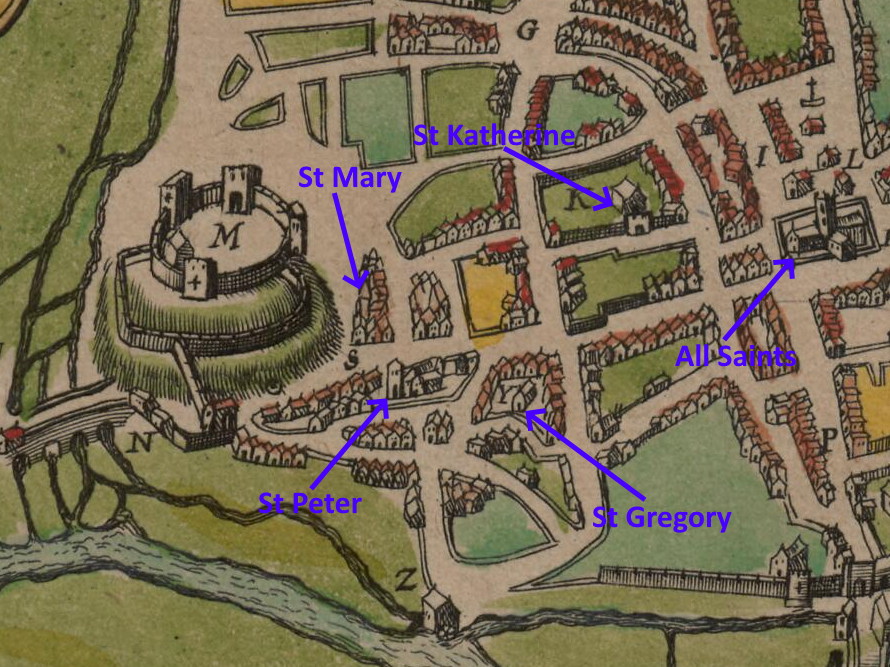
Recent research suggests that early in his tenure he probably rebuilt the church of St Peter in Northampton, echoing his father’s work at Holy Sepulchre6.
The unwritten part of Simon II’s story is that it was most likely his ambitions in reclaiming the family estates and earldoms that were the impetus for his personal mission to build a convincing inheritance story. Those ‘inventions’ became the substance of medieval myths.
There is also evidence that the Senlis family during his tenure attempted to create for themselves an origin myth that legitimised their Norman earldom by direct association with Saxon saint cults: St Guthlac at Crowland and St Ragener at Northampton7.
3. Simon III de Senlis (d. 1185): The Reconqueror
Recognised as Earl of Northampton upon reaching his majority in 1159, Simon III was determined to recover the Earldom of Huntingdon, which King Henry II had granted to the Scottish royal house.
When Henry II’s sons launched a massive rebellion against their father in 1173–1174, Simon III stood by the King. Henry II promised Simon that if he could wrest Huntingdon from the Scots militarily, the earldom would be his. In June 1174, Simon led the royalist siege against Huntingdon. He captured the town in July, expelled the Scottish garrison, and reunited the Earldoms of Northampton and Huntingdon under the Senlis name. He married Alice de Gant, heiress of the Earl of Lincoln.
4. Simon IV de Senlis (d. before 1185): The Rediscovered Son
For centuries, historians—including André Du Chesne—believed that Simon III had died entirely childless (trespassa sans enfans). However, Rev. Serjeantson uncovered a crucial charter in the cartulary of St. Andrew’s Priory8 that revealed the existence of a fourth Simon:
“Know all present and to come that I, Simon, the Earl, for the safety of my soul… on the day of the burial of Simon my son, have given to the Church of St. Andrew, Northampton… the advowson of the Church of Wyssendene9…”
This document proves that Simon IV de Senlis existed, but tragically died young during his father’s lifetime.
The Tangled Scottish Royal Connection and the End of an Era
The history of the English Senlis branch was inextricably linked with the Scottish Crown. Countess Matilda’s second marriage to King David I created a complex family web where half-brothers fought over earldoms while building abbeys.
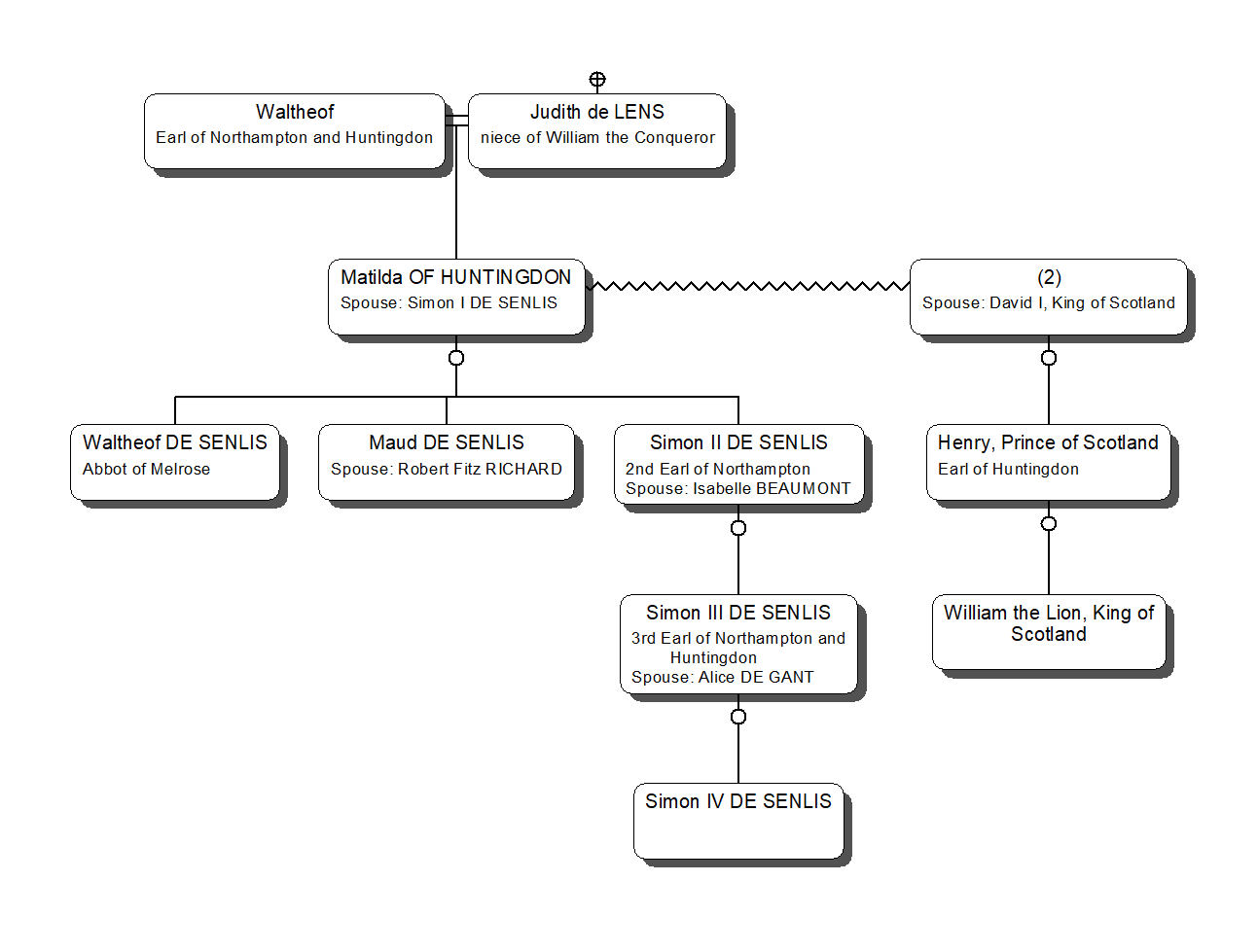
For instance, Waltheof de Senlis, the second son of Simon I, rejected worldly titles to enter the Cistercian order. He became the revered Abbot of Melrose in Scotland. Known for his saintly humility and visions, Waltheof used his spiritual authority to guide both his Senlis relatives and his Scottish royal half-kin. He probably persuaded his brother Simon II to found Sawtry Abbey, convinced his half-brother Prince Henry of Scotland to found Holm Cultram Abbey, and induced his stepfather King David I to establish Kinloss Abbey. Waltheof was canonised as a saint following his death in 1159.
When Simon III died in 1185 without surviving male issue (Simon IV having predeceased him), the male Senlis line in England came to a close. The Earldom of Northampton reverted to the Crown and became extinct, while King Henry II granted the Earldom of Huntingdon back to William the Lion, King of Scotland.
A Lasting Dual Heritage
The story of the Senlis family highlights the trans-Channel realities of medieval aristocracy. In France, the elder line maintained their hereditary station as Grand Butlers to Capetian monarchs well into the 13th century, taking part in royal crusades from Acre to the Siege of Damietta in 1249. In England, the cadet branch left behind round churches, monastic houses, and a dynastic rivalry with the Kings of Scotland that filled the pages of medieval chronicles.
Through modern archival research, the myths of “Ranulph the Rich” and the “lame knight” have given way to a clearer picture: a noble French house whose ambition shaped two kingdoms across two centuries.
A useful lesson for family historians
There is a wider lesson here for anyone researching a family history. A pedigree can contain a genuine family connection while stories attached to that pedigree are much less reliable.
The Senlis family is particularly interesting because the later research did not simply discard the earlier work. Serjeantson used Du Chesne to correct one part of the accepted genealogy, while then questioning other parts of the story that Du Chesne had repeated. Modern historians have continued this process.
That is how good genealogy and local history develop. One source leads to another. A published pedigree suggests a connection. A later historian checks the original evidence. A date changes. A parentage is corrected. A colourful story turns out to be uncertain. And gradually the family tree becomes not necessarily simpler, but more honest about what we actually know.
For the Senlis family, that process takes us from the great French house of Senlis to medieval Northampton — and leaves us with a story that is perhaps less romantic than the old legend, but considerably more interesting.
Acknowledgement: I am grateful to Steve Holder for peer reviewing this post and offering helpful advice and early access to his PhD thesis.
- The Grand Butler of France (Grand Bouteiller de France) was a historic high office of state responsible for managing the royal wine cellars and vineyards until the French Revolution of 1789
- The House of Capet ruled the Kingdom of France from 987 to 1328.
- André Du Chesne (often called the father of French history) completed the manuscript around 1636, shortly before he died in 1640. Although the detailed genealogical work was prepared for printing by the author himself, it remained in manuscript form and was later circulated via copies before being formally published much later in 1879 by Librairie Historique de J.-B. Dumoulin under the editorship of L. Sandret.
- Serjeantson, Rev. R. M. The Origin and History of the de Senlis Family, Grand Butlers of France and Earls of Northampton and Huntingdon. Vol. 31, Part II. Associated Architectural Societies’ Reports and Papers. W K Morton & Sons, 1913.
- R M Serjeantson’s history of Holy Sepulchre, Northampton, includes these three ‘myths’. See Cox, John Charles, and Robert Meyricke Serjeantson. A History of the Church of the Holy Sepulchre, Northampton. 1897. p22-23
- Eleanor Parker, Dragon Lords: the History and Legends of Viking England (London, 2018), p. 85.
- Unpublished PhD thesis: Steve Holder, Northampton c.1300-1350: Trade, Governance and Society in an East Midlands Borough, 2026
- Cartulary of St. Andrew (Cotton MS., “Vespasian E.,” xvii., f. 7).
- Whissendine, Rutland
© Copyright : Graham Ward. All rights reserved.