
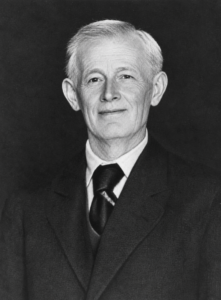
Edmund Francis Moore
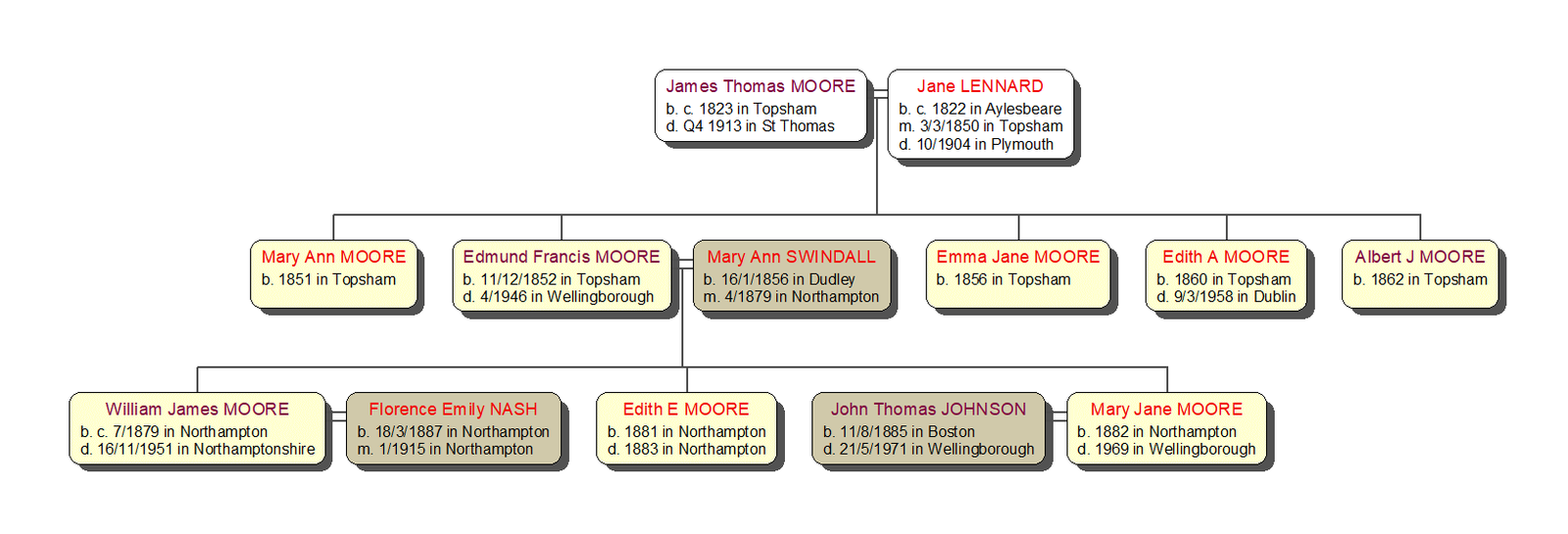
Edmund Moore was born in Topsham, Devon, the second of five children of James and Jane Moore. His father was a tallow chandler (candle maker). Edmund trained as a printer in Topsham. However, by 1879 he had moved to Northampton and married Mary Jane Swindall, who came from Dudley, Worcestershire. In the 1881 census, the family, now including the first two children, William and Edith, were living in Leamington Spa, Warwickshire, where Edmund was working as a printer. Significantly, those two children had been born in Northampton and Edith was only 7 months old; consequently, they had only recently moved to Leamington. Sadly, Edith died in the last quarter of 1883 when the family was back in Northampton.
10 St Michael’s Road
The houses in St Michael’s Road appear to have been built about 18791.
In the 1881 census, number 10 was occupied by George Gayton, a shoemaker; Lucy, his wife; Joseph, his 19-year-old son; and Uriah Gayton, George’s older brother, described as a lodger and also working in the shoe industry as a pressman.
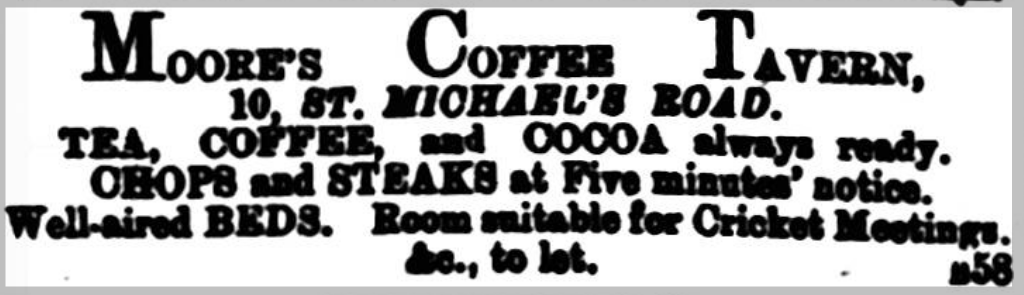
From 1887 these advertisements appeared regularly in the Northampton press, indicating that in addition to printing, the four-floor premises in St Michael’s Road also hosted a coffee house, a meeting room and some accommodation:
An interesting short letter appeared in the Northampton Mercury in October 1887 after an earlier advertisement for a ‘Black Flag’ procession in the town, which was using the 10 St Michael’s Road address to collect funds. The “Black Flag” was a 19th-century anarchist group that had spread to England probably from France and America in the 1870s.
Sir,—In consequence of an advertisement in the Reporter requesting subscriptions to be forwarded to the Café, 10, St. Michael’s-road, in aid of the “Black flag”’ procession, and to prevent an impression that I am in any way connected with the same, allow me to say that I am entirely opposed to such a thing, though subscriptions may be left here for that purpose.
Edmd. F. Moore,
Oct. 12th, 18872
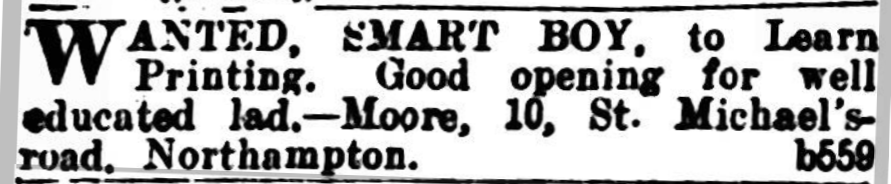
The printing business seems to have been successful, since over the years, advertisements appeared for staff:

The same style and similar content was being used over 30 years later:
As a coffee tavern proprietor, it is not surprising to find Edmund participating in a Good Templar event, a prominent temperance organisation, in 1879, where he recites the words of a popular temperance hymn “Go, feel what I have felt”3. By 1889 Edmund had risen to the position of Northampton District Secretary for the Good Templars4.
In 1938, a press report in the Northampton Mercury shows that Edmund was still active in the Typographical Association5, a print workers’ union with strong links to the Labour Party sponsoring several successful MPs in the first half of the 20th century.
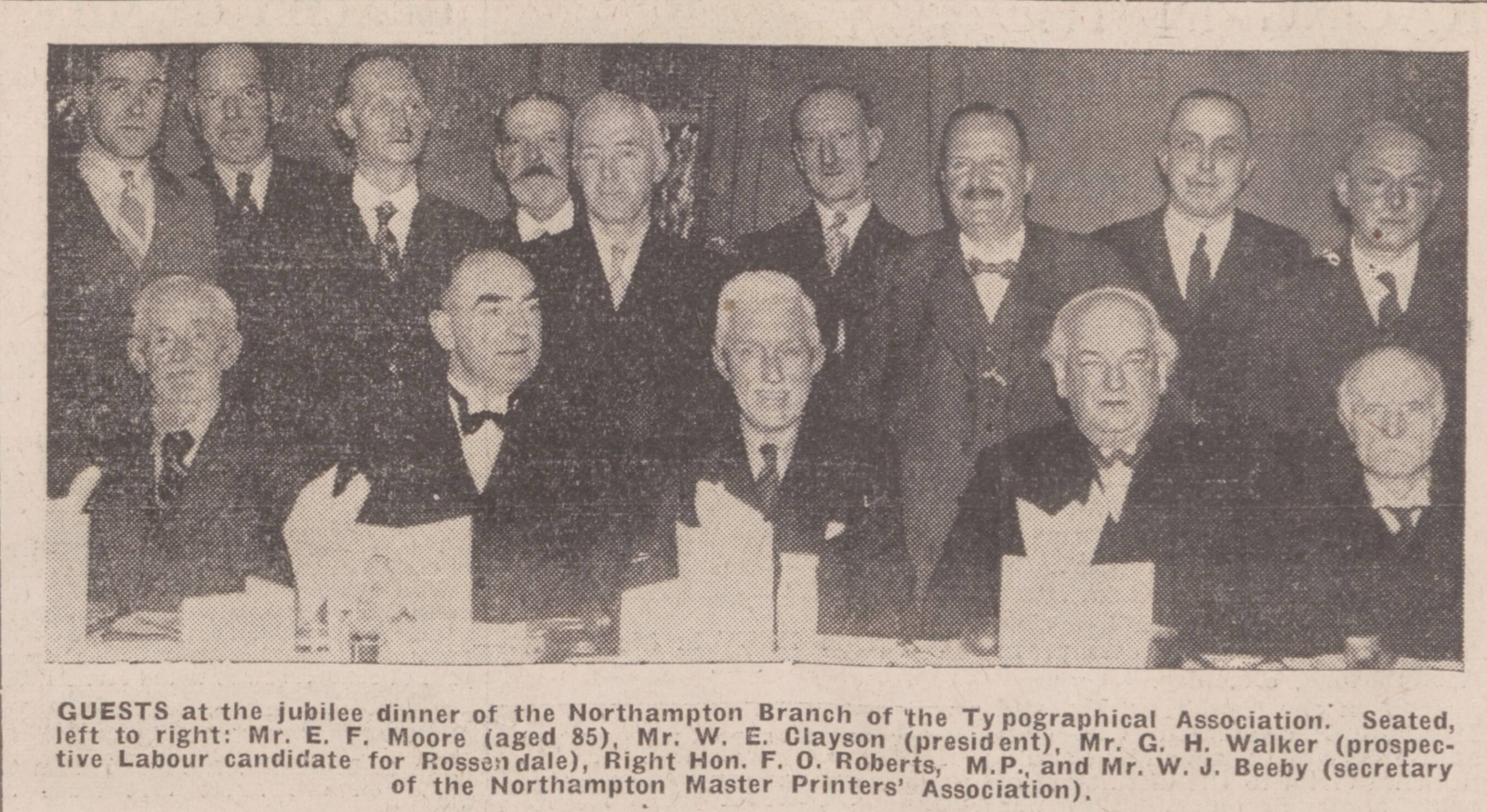
Following Edmund’s retirement, probably in the early 1920s the printing business was continued by his son William.
Edmund celebrated his 93rd birthday in December 1945 when he was living with his daughter, Mary Jane and son-in-law John Johnson in Wellingborough. He died in Wellingborough in April 1946.
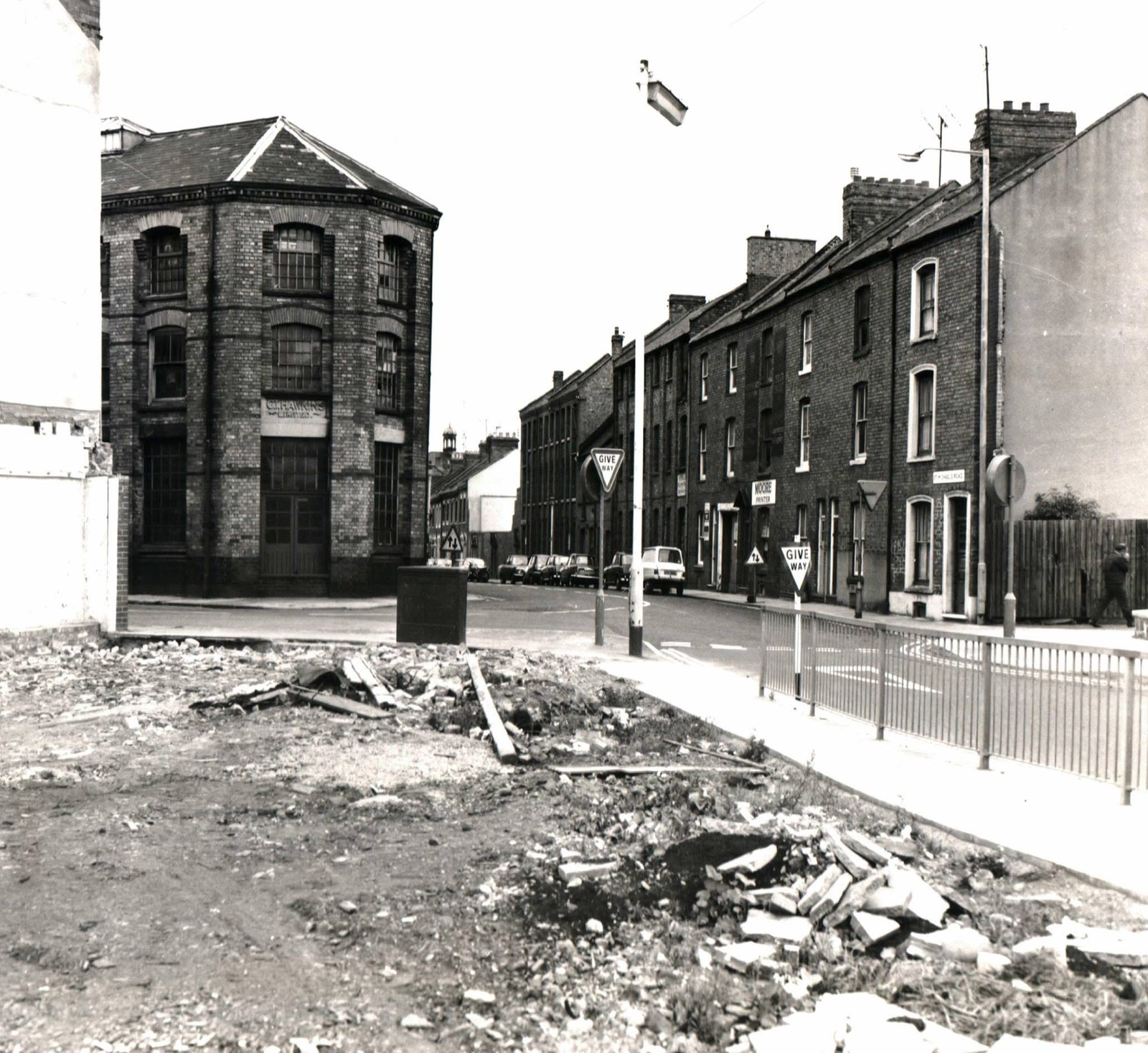
William retired in 1948, and after he died in 1951, the 1956 Kelly’s Directory shows the proprietor of the printing business was now Harold G Walmesley, who was probably previously employed by the Moore’s. This has been confirmed by a later owner, Paul Calcott, who purchased the business in 1993 from Moore’s former apprentice. Until the sale in 1993, the business continued to trade as Edmd. F. Moore or Moore’s Printer. Harold Walmesley died in Northampton in 2012.
Following Paul Calcott’s acquisition, the business name was changed to Pascal Print, and it continued until it outgrew the premises, which were sold to a property developer in 2000. The business moved to Tweed Road, Weedon Road, until it was finally sold in 2003.
- ”FOUR substantially-built FREEHOLD DWELLING HOUSES and APPURTENANCES, being Nos. 6, 8, and 10, St. Michael’s Road, and One larger Ditto, No. 12, also situate in the same street, WILL BE SOLD BY AUCTION, By W. J. PEIRCE.” Northampton Mercury, Saturday, 26 April 1879, p 4
- Northampton Mercury – Saturday 15 October 1887
- Good Templary, Northampton Mercury – Saturday 18 October 1879
- Good Templars at Stoke Bruerne, Northampton Herald – Saturday 10 August 1889
- Northampton Mercury – Friday 21 January 1938
© Copyright : Graham Ward. All rights reserved.