
Annual Commemoration and the Guided Walk
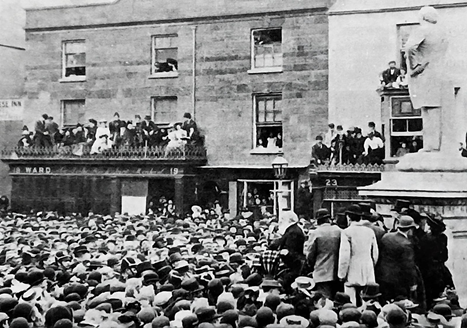
On the afternoon of Sunday 27th September 2026, a group of twenty gathered at Charles Bradlaugh’s statue in Abington Square to pay homage to Northampton’s illustrious Member of Parliament, who was born on 26th September 1833 and represented our town between 1880 and 1891. We have been holding these commemorations since 2002, and this year’s theme of ‘Giuseppe Garibaldi and Charles Bradlaugh’s Italian Adventure’ was inspired by a discussion in the Charles Bradlaugh Pub last September.
We agreed to make a visit to the nearby Garibaldi Hotel in Bailiff Street for post-commemoration refreshments and to renew the historical association between Bradlaugh and the legendary Italian revolutionary. This year we were pleased to be able to expand on these plans by also incorporating a guided walk led by the Northamptonshire Radical History Group that included visits to two locations associated with Bradlaugh in the area popularly known as ‘Heretics Corner’.
The Origins of ‘Heretics Corner’ and Resistance to Church Taxes
After our commemoration at the Bradlaugh statue, we headed towards the Garibaldi Hotel. We made a slight detour via the area behind his statue, at the bottom of the Kettering Road and the corner of St. Michael’s Road where there is a concentration of Nonconformist and Dissenter chapels and churches. Many years ago an Anglican evangelist neighbour once referred to this area as ‘Heretics Corner ’, and I was pleased to learn more recently that this was not a term of his own but one that had been in common use over the years.
Charles Bradlaugh lectured and wrote under the pseudonym ‘Iconoclast’, and he is without doubt the best known of our local ‘heretics’. The nonconformists of the early –mid nineteenth century chose this location adjacent to his statue for their places of worship because it was outside the town boundary, and it enabled them to escape the ‘church tithes’ and ‘vicar’s rates’ – the taxes imposed by the Anglican churches on residents within the town to cover the maintenance of church property and pay the wages of their vicars.
In 1868 The Compulsory Church Rate Abolition Act outlawed the tax nationwide. However, twenty years earlier,in 1848 intense local resisitence from nonconformists and ‘scenes of riotous protest’ had persuaded Wiillaim Wales of All Saints and William Butlin, the vicar of St.Sepulchre to make the Church Rate a voluntary levy. St.Giles continued to insist on compulsory payment as before.
A shared antipathy to the privileged powers of the established church was an important factor contributing to the unlikely alliance of the notorious atheist and many of Northampton’s most devout Christians. A key episode occurred in 1860, the same year as Bradlaugh’s Northampton meeting in support of Garibaldi. Two of the town’s leading secularists, John Bates, a newsagent based in the Drapery who was to be Bradlaugh’s first election agent in 1868, and Joseph Gurney a town councillor and a draper in Gold Street, encouraged local nonconformists to join them in refusing to pay the ‘Vicar’s Rate’, recently re-introduced and imposed on residents by the Rev. Sidney Gedge, the new incumbent at All Saints Church.
Gedge unwisely prosecuted the non-payers. When Bates posted an article by Bradlaugh in his shop window alongside a handbill written by a nonconformist critical of the Vicar’s Rate, Gedge took action for libel. Bradlaugh supported them in the pages of his newspaper, the National Enquirer and wrote personally to Gedge, appealing to him to reconsider. The Queen’s Bench dismissed both prosecutions, and Gedge had to pay the costs.
First Stop: The Unitarian Church and Early Nonconformist History
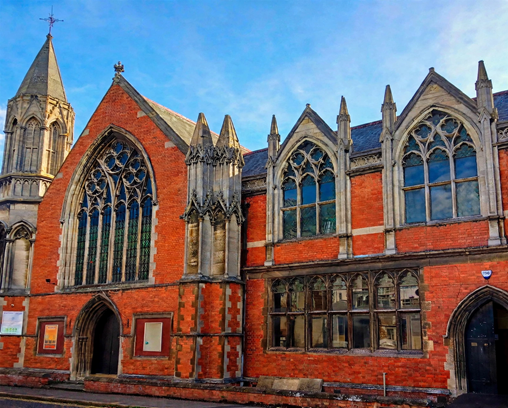
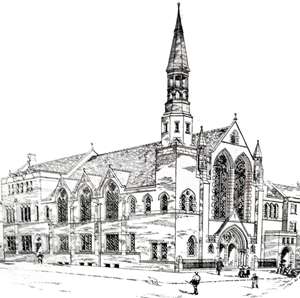
Our walk’s first destination on ‘Heretics’ Corner’ was one of Northampton’s grandest churches. Only a short walk from Bradlaugh’s statue at the junction of the Kettering and Wellingborough Roads, stands the Kettering Road Free Church, more widely remembered as the Unitarian Church. Local Unitarians were some of Bradlaugh’s strongest supporters from the time of his first election campaign here in 1868.
The small group that became the Northampton Unitarians were originally attendees of the Castle Hill Congregationalist Chapel, now the Castle Hill United Reformed Church. Castle Hill, built in 1695, was the town’s first nonconformist church and had previously been associated with the influential cleric Phillip Doddridge. In the mid-17th century, the famously tolerant and anti-dogmatic theologian set up the Northampton Academy to provide a liberal education for students and future church ministers who were automatically barred from Oxford and Cambridge on account of their nonconformity.
In 1827, the arrival of the traditionalist Rev. Hyatt at Castle Hill led to the departure of 9 members of the congregation who were to become the Northampton Unitarians. Hyatt was determined to root out heresy and would certainly have been intolerant of any rejection of the ‘Trinity’, the belief in a single ‘unified’ God, and the Unitarian emphasis on human reason and individual conscience rather than blind obedience to a strict set of religious dogma!
The small group reconvened for meetings at the Fountains Inn on the corner of Silver Street and Bradshaw Street (later renamed The Criterion and currently the Boston Clipper) and eventually managed to buy a former Wesleyan Chapel (now demolished) in King Street for £500. Their first service was 21st September 1827. By 1832 they were holding 3 services every Sunday, with attendances of up to 200.
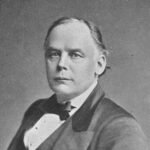
Phillip Manfield, Unitarianism, and Political Alliances
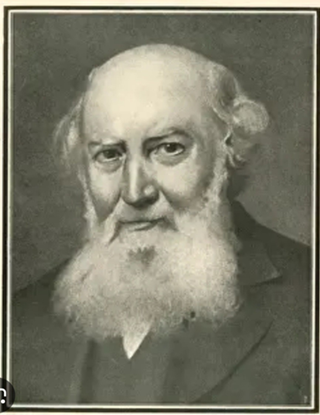
In 1843 they were joined by Phillip Manfield (1819-99) – also known as Moses P. Manfield – who had come to Northampton from Bristol and was employed as a foreman for a small boot and shoe manufacturer. With some help from the Unitarians, he set up his own business, which quickly grew to become a highly successful footwear manufacturer and retailer. Fifty years later, Manfield and Sons managed three local factories and a network of 93 shops.
Orthodox Victorian Christians, and probably the majority of local nonconformists, would have regarded the relative beliefs of Unitarians and atheists (as personified by Bradlaugh) as both ‘heretical’ and ‘blasphemous’. Despite profound theological differences, the tolerance and flexibility of Unitarianism, particularly of those amongst the rationalist wing of the movement, allowed for an often close alignment with organised secularism.
In common with other nonconformists, their historical experience of persecution made the Unitarians natural defenders of individual conscience, and after 1880 they viewed the campaign to exclude Bradlaugh from Parliament not as a triumph for Christianity as it was sometimes claimed, but an infringement on constitutional rights and democratic representation. When Bradlaugh announced his candidacy in July 1868, local Unitarians who lent him their support were joined by others from further afield. The Rev. James Applebee of Stoke Newington Green Unitarian Chapel in London ’at once packed my gripsack and travelled down to Northampton, with the view of doing what I could to aid’. In 1874 the prominent local Unitarian Frederick Covington threw in his lot with Bradlaugh, and after 1880 Moncure Daniel Conway, the well-known American abolitionist and freethinker, and the Unitarian minister of South Place Chapel Finsbury, was to become one of Bradlaugh’s most important supporters.
However, in 1868 Phillip Manfield, then the chairman of the local Unitarians and a leading member of the local Liberal Party, opposed Bradlaugh’s applications for one of the party’s two candidacies, obliging Bradlaugh to stand as an independent Radical. The Liberals continued to reject Bradlaugh’s applications before the general election of March 1874 and the by-election of October of the same year when the divided liberal vote had let in Tory Charles George Mereweather, provoking Bradlaugh’s supporters to riot in the town centre. Manfield’s attitude changed three weeks before the 1880 General Election when one of the party’s two chosen candidates, the moderate liberal Acton Smee Ayrton, was seriously injured after falling from his horse and had to withdraw from the contest. Manfield saw that the continued division over Bradlaugh would let in the conservatives again.
He acted quickly to get the support of the local party, taking a firm stand against a small group of anti-Bradlaugh die-hards led by the Rev. Thomas Arnold of Castle Hill, before travelling to London to consult with the Chief Whip. He managed to arrange an agreement for Bradlaugh to replace Ayrton as the second Liberal Party candidate for the town, alongside James Labouchere MP, who was sympathetic to Bradlaugh and agreed to share a joint platform with him. Manfield backed Bradlaugh through the difficult years of his exclusion from Parliament and the four by-elections that came about due to the dispute over the Oath of Allegiance. After Bradlaugh died in 1891, Manfield was elected to succeed him in Parliament. He was knighted in 1894, and funded the construction of the new Unitarian church in 1896.
The size of their congregation decreased significantly throughout the 20th century, and in 2015 they moved to a new home, the Unitarian Meeting House, just off Horsemarket and opposite Sol Central.
Second Stop: St. Michael’s Road, Union Chapel, and Baptist Controversies
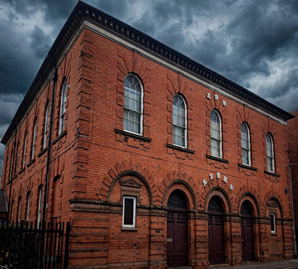
Our next stop was halfway along St. Michael’s Road, just past the small Wesleyan, Christadelphian and Spiritualist chapels. The imposing Union Chapel, built in 1885 to accommodate 1,000 worshipers, is now a Buddhist temple, and in Bradlaugh’s day was the base of one of his fiercest critics, the Baptist, Rev. Henry Bradford. After the Methodists, the Northampton Baptists were the most numerous of the nonconformists, and generally of a politically radical persuasion. Many were amongst Bradlaugh’s most enthusiastic supporters, but his controversial theological views meant that some local congregations were bitterly divided.
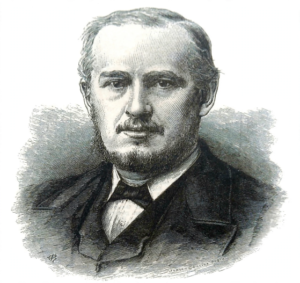
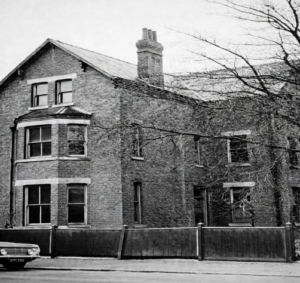
Henry Bradford (1843-1895) first came to Northampton in 1882 to preside over the Princess Street Baptist Church (demolished in the mid 1970’s). In April 1884, at the time of one of Bradlaugh’s by-elections, Bradford made a series of sermons questioning the faith and integrity of those amongst his flock who supported Bradlaugh. At the next monthly church meeting, a majority of them voted to sack Bradford. Bradford’s supporters split away and organised a national campaign to fund the construction of a new chapel for him in St. Michael’s Road. They also built his family a home at 44 Kingsley Road facing the Racecourse, later known as ‘Bradford House’. It was demolished in the late 1960’s and replaced with a small block of flats, known today by the same name. There is an inscribed panel in the wall to commemorate Bradford’s fortitude after the humiliations of 1882.
After Bradford’s unfortunate departure, the Princess Street Baptist Church resumed its role as a beacon of progressive opinions within the wider Baptist community. In 1918, minister Frank Dardis (1885-1976) intervened to support congregant and conscientious objector Wilfred Church. In 1920 he spoke out when the Liberals and Tories opposed the nomination of borough councillor and conscientious objector Harold Croft for the role of Alderman. Croft had been court-martialled three times and imprisoned 1916-1919. In October 1919 Dardis was selected to stand as a Labour candidate for the council seat of Abington, but his candidature was ruled out of order because of his role as a clergyman. In February 1921 he disassociated himself from the Northampton Free Church Council’s decision to refuse admission to the Unitarians.
Conclusion at The Garibaldi Hotel
We were happy to conclude our walk at The Garibaldi Hotel, the first of many ‘Garibaldi’ pubs that have come and gone in Northampton over the years, which has thrived in Bailiff since 1860, the year of the great man’s most intense military campaign in Italy and the public meeting organised by Bradlaugh to rally support.
Our journey’s end was the nearby Lab Club on the corner of Charles Street and Earl Street, where our now slightly diminished and slightly intoxicated group pondered the theme of next year’s 25th commemoration whilst enjoying a Garibaldi cocktail; freshly squeezed Sicilian oranges on ice with a dash of Campari from the northern city of Milan – a blending of north and south to represent Italian unification.
There is much more to be said about the role of Northampton’s nonconformists amidst the controversy and passion of the political battles in Northampton between 1868 and Bradlaugh’s death in 1891. 21st June 2027 will be the 150th anniversary of Bradlaugh and Anne Besant being convicted of ‘obscenity’ after they republishing a cheap edition of a birth control manual – that scandal really did put the cat amongst the pigeons and had massive impact on Victorian attitudes to sexuality and the sizes of their families!
Thanks to: Sue Woolley of Northampton Unitarians, John Buckle and Russell Hickman of The Northamptonshire Radical History Group, Anthony Solomon of Heyford Books and Graham Ward of Northamptonshire Nonconformists edintone.com.
Chris Pounds, Oct 2026
© Copyright : Graham Ward. All rights reserved.